Key Takeaway
We make stainless steel drinkware in Wuyi, Zhejiang, China. Our name is Quanhu, and we have been in business since 2020.
If you are considering us for your next bottle or cup collection, you probably want to see more than a company description. You want to know what we actually manufacture, how your branding would fit the product, and what working with us would involve. This is where we can give you a closer look.
The photographs and video frames in this article come from our factory materials. They show bottle bodies at a forming press, cups on coating-line fixtures and people working along an assembly line. We have also included a bottle from our own range, with its material specifications and dimensions, so there is a finished product to put beside those workshop views.
Our catalog extends beyond the products we manufacture ourselves. We will explain that distinction too. It is part of understanding our business, and it matters when you choose a product for yours.
What we make in Wuyi
Bottles, tumblers, coffee cups and water jugs make up our own stainless steel drinkware range. We work with brands and wholesalers on existing products and discuss development when a project calls for something different. Logos, exterior colors, finishes and packaging are among the details that can be adapted to the selected model.
The company behind Quanhu is Zhejiang Qualflask Industry & Trade Co., Ltd. Our factory is in Wuyi, in Zhejiang Province. You will see Quanhu throughout this website and may encounter the legal company name in business documents. Knowing both names makes those documents easier to connect with the products you have seen here.
Our product collections also include items available through partner suppliers. We keep this distinction clear: having our own factory does not mean that everything in a broad catalog is made at that factory. The manufacturing or supply arrangement belongs to the individual product.
Suppose you are interested in one of our stainless steel bottles and a lunch box from another collection. You can discuss both with us, but the bottle's ordering conditions should not be carried over to the lunch box. The available decoration, samples and minimum quantity may differ. We need to look at each item on its own terms.
For buyers who want to concentrate on our bottles, the stainless steel water bottle collection is a useful place to start. Pick a few shapes that suit your customers, then tell us what attracted you to them. It might be the size, the closure, the outline of the body or the space available for branding.
You do not have to settle every detail at that stage. A shortlist is enough to begin. What helps is knowing which features are essential and which you are still willing to change. A fixed body shape with flexible color options is a different brief from a fixed brand color with several possible bottle shapes.
Three views from our factory
The finished bottle is the part your customer sees. These images show some of the work before it reaches that point.
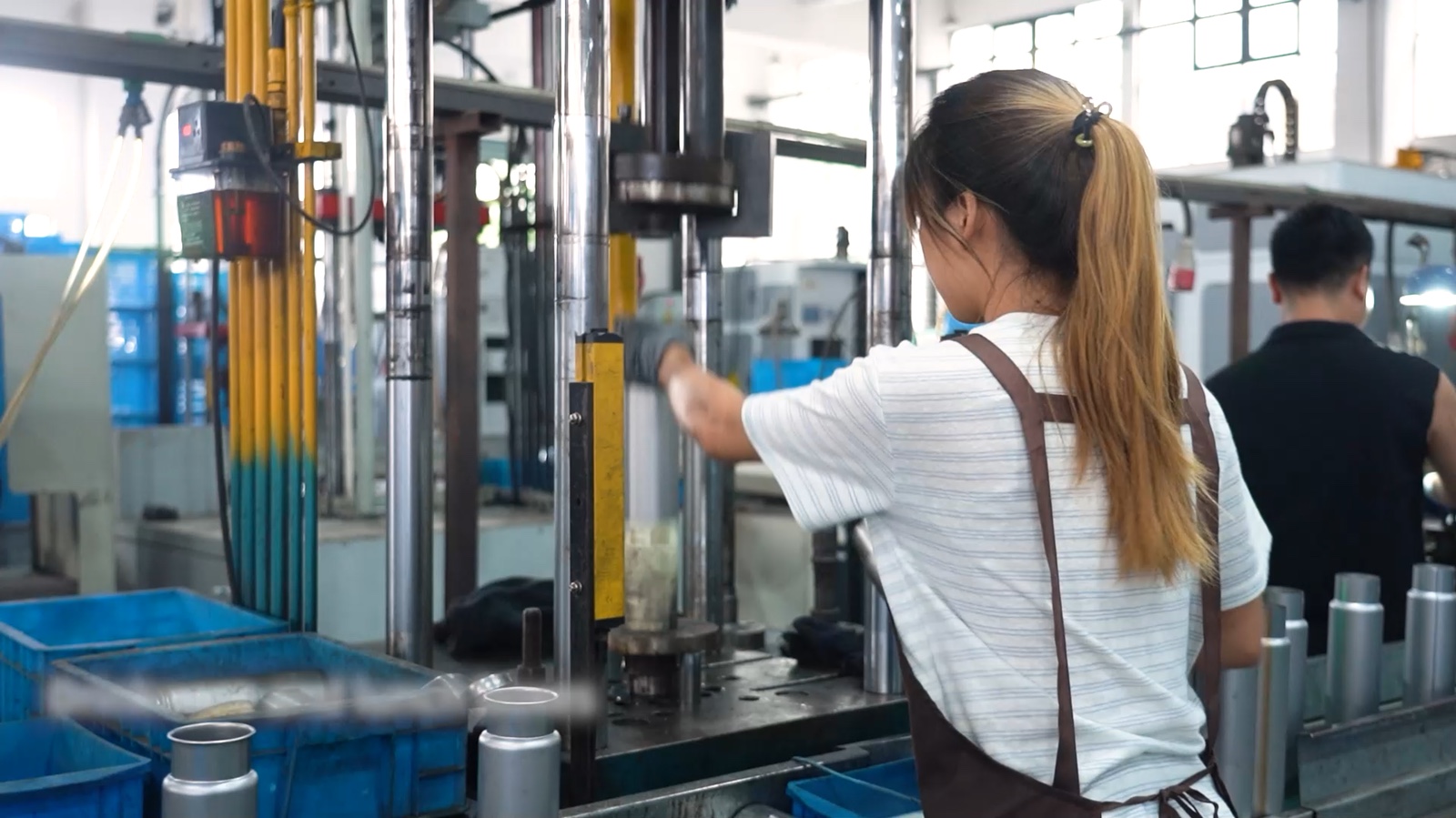
In the opening workshop image, a worker is operating a forming press. Stainless steel bottle bodies stand beside the equipment, with more pieces collected in blue bins. The scene gives a close view of the body-making side of our operation, before the product has the exterior appearance you would recognize in a catalog.
When you look at a bottle design, the body is a good place to begin. Its shape sets much of the product's visual character. A straight-sided bottle and a wider, handled cup offer different surfaces for artwork and a different experience in the hand. Those are things to explore with an actual model, especially if your brand already has a particular silhouette in mind.
We can discuss an existing body from our range or look at a proposed new design. Keeping those two routes separate at the beginning helps explain what the project needs. Adding a logo to an existing bottle starts from a product that already exists. Changing the body shape introduces development work that has to be considered before the production order.
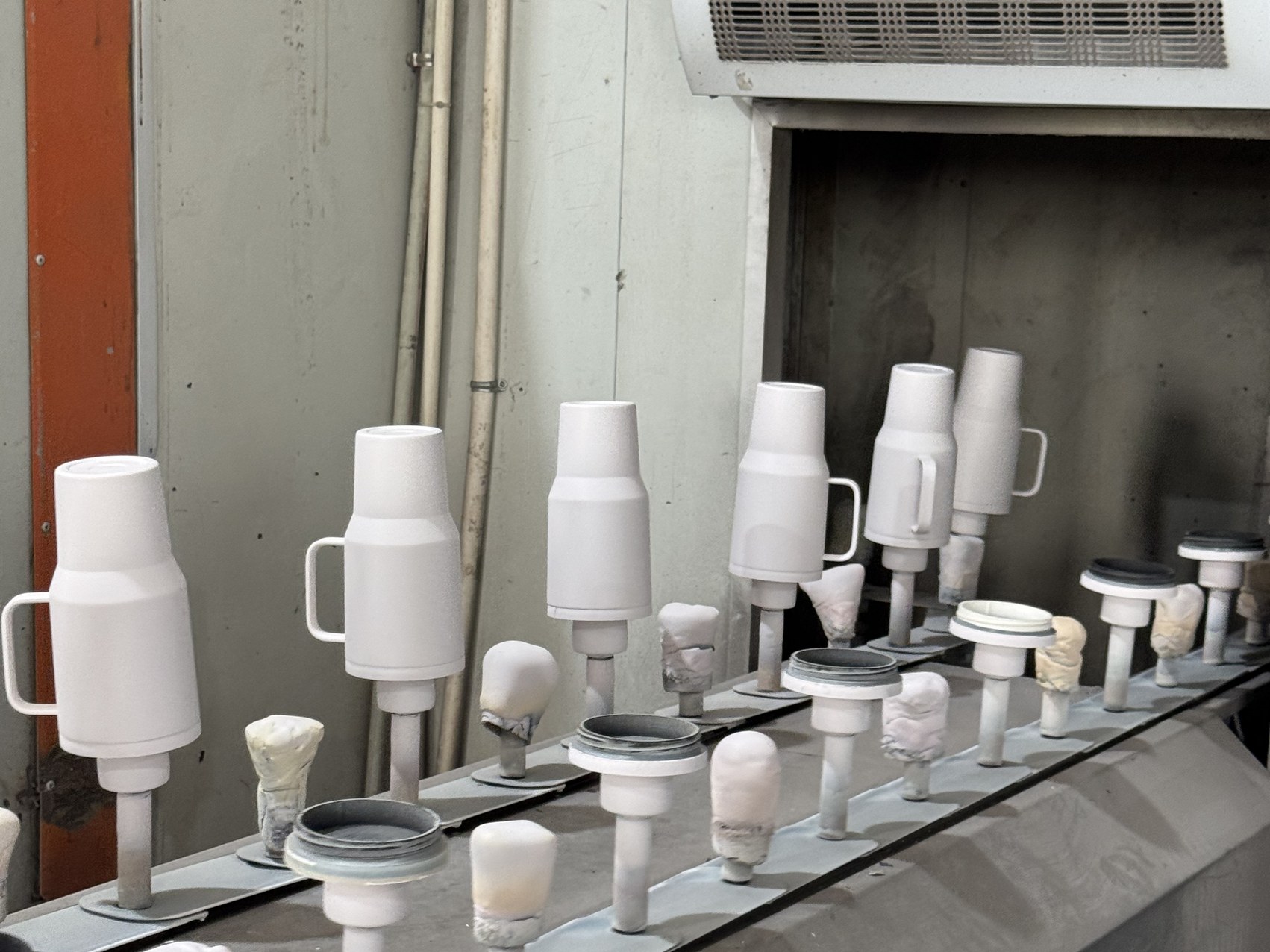
The second photograph shows cup bodies mounted upside down on fixtures. Here, the product's exterior finish becomes easier to picture. The white cups and their handles are visible, along with the fixtures carrying them through this part of the work.
For a branded collection, color and finish can be as noticeable as the shape itself. Bring us the color reference you use for your brand, and tell us whether the surface should have a particular appearance. A screen image is a useful introduction to an idea; a sample gives you something to put beside your packaging or other products.
The color in this photograph is an example of factory work, rather than a stock list. Available standard colors depend on the selected product and current inventory. If you are open to an existing color, say so. If your exact brand color is essential, that should be part of the first conversation.
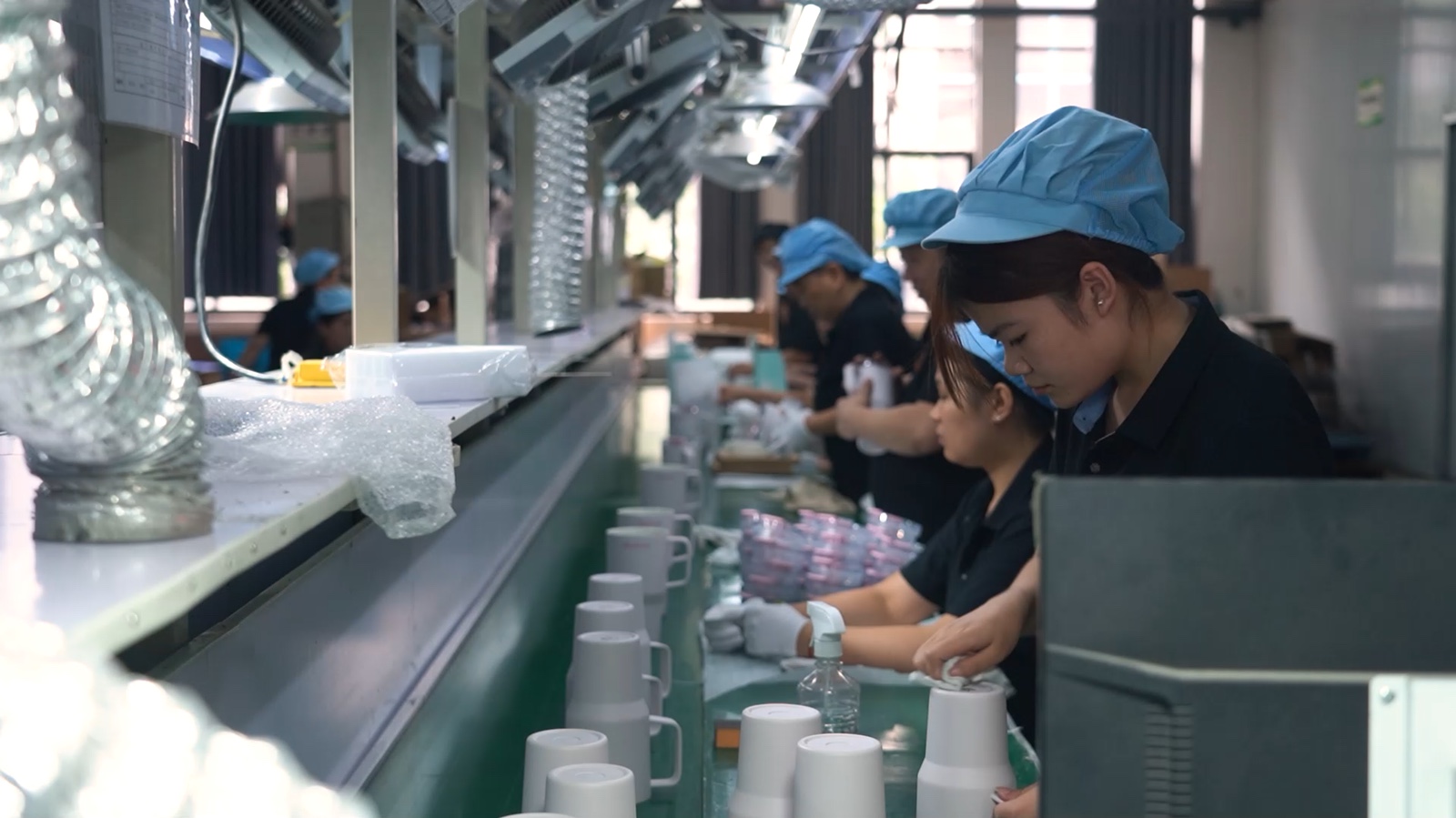
The third image brings the people and product parts into view together. Cup bodies are arranged along the line, and workers are handling them at their stations. By this point, a buyer's choices about the body, closure and accessories need to describe one finished item.
A useful product brief therefore goes beyond the outside shape. If a lid is a deciding feature, include it in the request. If you want a carrying feature or another accessory, point it out. A similar-looking part from another bottle is a reference to discuss, not evidence that it will fit the body you have chosen.
These images are a small selection from our factory photographs and footage. More views of the site are available on our factory page. If you want to discuss a visit or a video conversation, contact us with the products and questions you would like to cover so the arrangements can be considered.
One bottle in detail
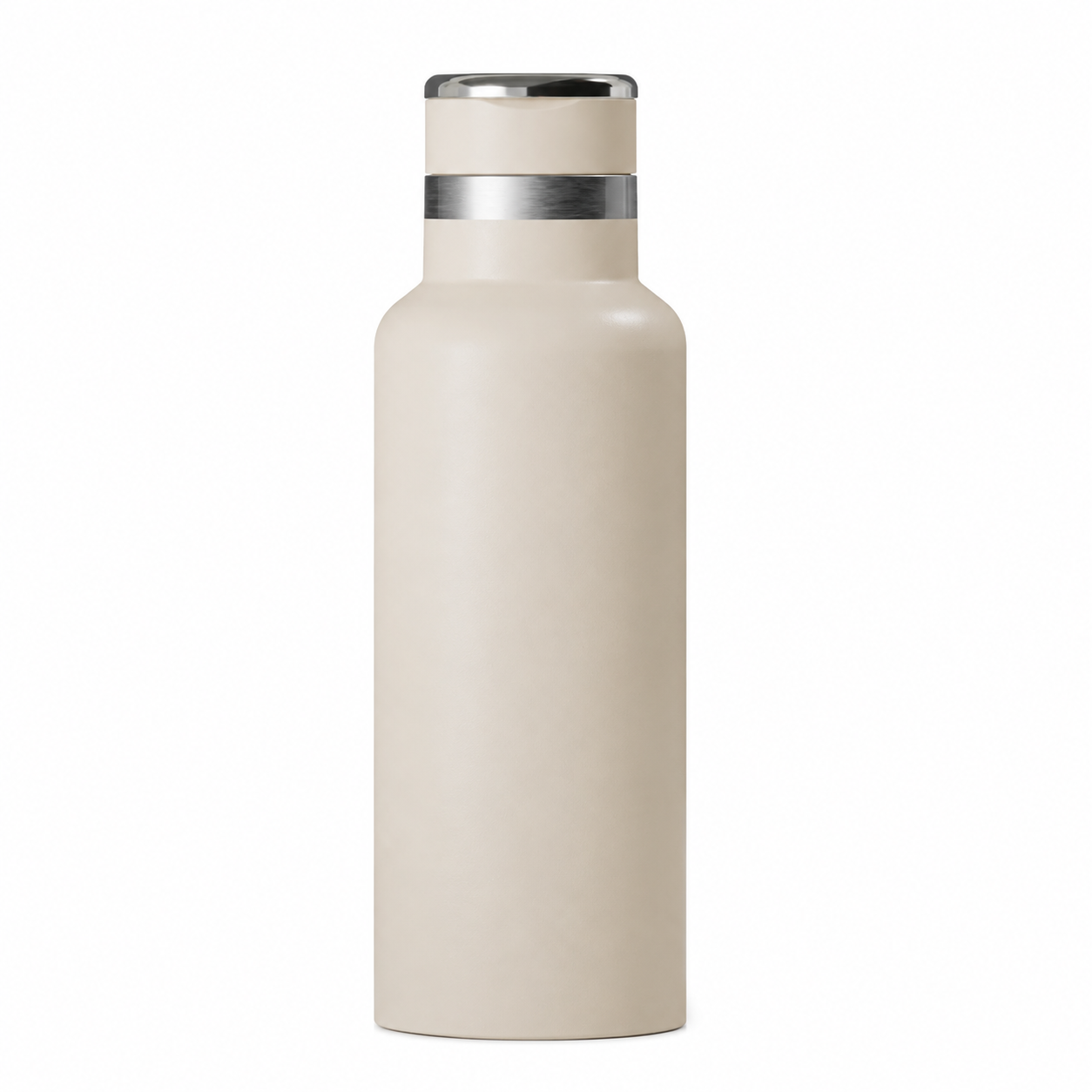
S4807V-16oz is one of the bottles in our own range. Its catalog image shows a light neutral exterior, a rounded shoulder and a contrasting metallic band near the top. It is a useful example because the appearance is simple enough to see the outline clearly, while the specification adds details a photograph cannot show.
| Part or measurement | S4807V-16oz specification |
|---|---|
| Inner body | 304 stainless steel |
| Outer body | 201 stainless steel |
| Seal | Silicone |
| Product dimensions | 78 × 78 × 195 mm |
| Individual box dimensions | 8 × 8 × 23 cm |
Notice that the inner and outer steel grades are listed separately. Calling the whole bottle “304 stainless steel” would lose an important part of that description. If your purchasing specification calls for a particular material, tell us which part it applies to. Your requirement may concern the inner body, the exterior, or several components.
The dimensions give you another way to judge the product. You can compare them with the space available on a display or in the packaging arrangement you have planned. If a close fit matters, a physical sample is the next sensible step. The photograph is good for assessing the overall shape, but it cannot settle a fit question on its own.
The box measurement needs a little care. It describes an individual box for one product. It is not the size of the master shipping carton, and it does not tell you the weight of a packed shipment. Those are separate details to request when you are preparing the order and its transport arrangements.
There is a similar distinction between the catalog image and a branded sample. The image lets you see the body and exterior presentation. Your own logo will have a size and position, and your requested finish may look different from the one shown. That is why it helps to send the artwork early enough to discuss it on the actual model.
You can find the bottle on the S4807V-16oz product page. Use that reference in your inquiry, even if you also attach the picture. It avoids confusion with another size or a similar body from the same collection.
For a first conversation about this bottle, you might already know the quantity and logo position but still be undecided about color. That is enough to tell us. We can discuss the open choice alongside the details you have already settled, without asking you to start the product selection again.
Putting your brand on an existing product
An existing bottle can provide the starting point for a branded collection. The product already has a defined shape, and the work turns to the details that will make it recognizable as yours.
For our own stainless steel range, the options we discuss include logo decoration, exterior color, surface finish, selected plastic components and packaging. The available combination depends on the model. Here is how to make that conversation useful without preparing a large design document first.
Start with the logo artwork and where you would like it to appear. Laser engraving and silk-screen printing are options for review on our own range. The method depends on the product and artwork, so include the intended size as well as the design file. A small wordmark near the base and a large graphic around the body are different requests, even if they use the same brand colors.
Next, describe the exterior. If you have a color reference, include it. If you are choosing from available standard colors, tell us which would work for your collection. It is also helpful to know what the bottle will sit beside. You may want to compare a sample with an existing box, a label or another item in the range before choosing the final appearance.
Lids and other components deserve their own line in the brief. Explain how you want the customer to use the product, and identify any part that is essential to that use. We can then look at the options for that body. Treating the closure as part of the product from the beginning is easier than discovering late in the discussion that the pictured lid was never the one you wanted.
Packaging is another place where a few details make a difference. Tell us whether you need an individual branded box, what artwork is ready and how the product will be presented. Keep questions about shipping cartons alongside the transport information, so retail presentation and shipment planning do not become mixed together.
You can leave choices open. For example, “the body shape and logo position are fixed, but we can use one of the available colors” gives us a useful starting point. So does “the color is essential, and we are willing to consider another bottle.” Both tell us where to focus the discussion.
What a first order can look like
For our own stainless steel range, orders can start from 500 pieces when the required bodies are available from stock and the project uses stocked standard colors. Custom exterior colors start at 3,000 pieces. Stock changes, so the quantity for the chosen product is checked when we quote. Partner-supplied items have separate terms.
That difference is worth knowing before you settle the design. Imagine that you want a first batch of 500 bottles with your logo. An available standard color may offer a route worth discussing. If the same project requires a specially matched exterior color, the 500-piece starting point does not describe that request. You would be considering a different order condition.
It also matters how the total is divided. An inquiry for 3,000 pieces spread across several bodies or colors is not the same brief as 3,000 pieces of one version. Send the quantities against each variant, rather than leaving us to guess what the total means. We will address the proposed mix in the quotation.
Before placing a bulk order, you can discuss samples from our own range. Our stated sample fee is USD 15, with shipping calculated separately, and the fee can be credited against a later bulk order. An uncustomized sample generally takes about three days to prepare; a customized sample takes about fifteen days. These are preparation times, not arrival dates, and the arrangements for your selected item still need to be agreed.
Choose the sample according to what you need to learn. If you are deciding whether the shape suits your collection, an uncustomized example may answer the immediate question. If the decision depends on how your artwork looks on the body, the decoration needs to be part of the sample discussion. You can ask about both before choosing how to proceed.
For standard orders of 500 to 3,000 pieces from our own range, our usual production estimate is 30 to 35 days, subject to the project. Tell us the date by which the goods are needed at their destination. Production and transport are separate parts of the schedule, and a required arrival date gives us more useful context than a request to make the order “as soon as possible.”
When your idea needs a new design
You may come to Quanhu with a product that does not match an existing model. We can discuss development, including a design that starts from your drawings or an idea that needs drawing work before tooling can begin.
At this stage, explain what you want to change and why. You might need a different body shape, a particular closure arrangement or a combination of features you have not found in the current collection. Reference images help describe the direction, while dimensions and component details help turn it into a product proposal.
It is useful to separate appearance from function in that first explanation. “We like this rounded shoulder” tells us about the outline. “The bottle must fit this space” introduces a size requirement. A marked drawing can show both, so the design discussion does not depend on interpreting a photograph in the same way.
For new mold development, our current planning reference is about 45 days to a first trial sample once drawings are ready. That is a development milestone, not a promise that a finished bulk shipment will be ready in 45 days. The project may need review and changes after the first trial.
If we undertake design work where drawings are not yet available, a design fee can apply; the amount and the arrangement are discussed for the project. Our stated arrangement allows that fee to be returned after mold development is completed. We would put the relevant terms into the project discussion before that work begins.
An existing model and a new design can both be valid starting points. What matters is choosing the route that fits the product you actually want to bring to market. If you are unsure, send the closest model from our range alongside the changes you have in mind.
Quality starts with knowing what the order should be
We maintain raw-material traceability, carry out sample checks of finished drinkware for appearance and function, and check finished products during packing. These are part of the quality work at our factory.
Your specifications give that work a reference. The agreed material, decoration and components describe what the finished order should be. If your team needs something beyond the standard product information, bring it into the discussion before the order is settled. A requirement that arrives after the sample has been reviewed may change what needs to be evaluated.
Documents should have the same connection to the order. If a report identifies a particular coating or ink, read it for that scope. It should not be stretched into a statement about every part of a finished bottle. A changed material or component also needs attention before an earlier report is used for the new version.
Our website has more information about quality control. When requesting documents, include the product and destination market, along with the requirement you need to address. That lets the conversation focus on relevant information, rather than a collection of certificates with no clear connection to the item you plan to buy.
We would also like to know which product claims you intend to use in your own listing or packaging. If a claim needs supporting evidence, it is better to raise the question while choosing the product than after the artwork has been finalized. We can discuss the available information and identify what needs further review.
A conversation about your product
You do not need to arrive with a perfect specification sheet. A first inquiry can be a short message with a few product links and an explanation of what you are trying to make. It helps if we can see where you are in the process.
If you are comparing shapes, tell us which features attracted you to each one. If you have chosen a bottle, send that model and the decoration you want to add. If you already have drawings, include the dimensions and the parts of the design that are still open. Each gives us a different place to begin.
Here is an example of the level of detail that is useful: “We are considering S4807V-16oz for our first branded bottle. The logo position is fixed, but we are flexible on exterior color. We would like to look at a sample before deciding on the packaging. Our initial quantity is 500 pieces, and the destination is listed below.”
The message makes a few things clear without pretending that the whole project is settled. There is a product reference, a design priority and a quantity. It also tells us which decisions the sample is meant to help with. An inquiry about a new body or a custom color would naturally look different.
After you receive a sample, describe changes in terms that can be put back onto the product. A photograph with the intended logo position marked is easier to act on than “make it look more balanced.” A color reference is more useful than “slightly warmer.” You can still explain the visual effect you want; the reference gives us something to work from.
Keep the latest version of the brief with those comments. If several people on your team are involved, it gives them one place to see what has been chosen and what remains open. It also helps avoid an older image or an early packaging idea finding its way back into the order by accident.
Bring us the bottle you want to make
The next step can be small. Choose a bottle you want to see in person, send the artwork you would like to put on it, or show us a design that needs further work. We can start from there.
Tell us about your product. Include the model or intended use, quantities by version, destination and target date, with any artwork or drawings you already have. Those details will let us get into the product you want your customers to hold.
Frequently Asked Questions
Does Quanhu manufacture its own drinkware?
Yes. We manufacture our own stainless steel bottles, tumblers, coffee cups and water jugs in Wuyi, Zhejiang, China. Quanhu is the brand name; the legal company name is Zhejiang Qualflask Industry & Trade Co., Ltd.
Is every product in your catalog made at your factory?
No. Alongside our own stainless steel range, our product catalog includes items supplied by partners. Ask about the model you are considering: its manufacturing arrangement, customization options and ordering terms belong to that particular item.
Can you put my brand on an existing bottle?
Yes. For our own stainless steel models, we can discuss logo decoration, body color, surface finish, selected plastic parts and packaging. Send the model and your artwork or reference images; the available options depend on the product.
Can I order a sample before choosing Quanhu?
Yes. Choose a model, such as S4807V-16oz, and say whether you want a plain sample or one with your logo. For our own range, plain samples usually take about 3 days to prepare and customized samples about 15 days. Shipping is additional; the sample fee and delivery cost are confirmed for your request.
Can I start with 500 pieces?
For our own stainless steel range, orders can start from 500 pieces when the bottle body is in stock and you use available standard colors. Custom colors start from 3,000 pieces. Stock changes, and partner-supplied items have separate terms. Our ordering FAQs explain more of the conditions to discuss before ordering.
How long would my first production order take?
Regular orders of 500–3,000 pieces from our own range typically take about 30–35 days in production, with shipping time added separately. New tooling follows a separate schedule. Send your model, branding requirements and target arrival date so we can discuss the timing for that order.
Can I see the factory before placing an order?
You can start with the workshop photographs and footage on our factory page. If you would like to discuss a visit or video conversation, send the products and questions you want to cover. We will discuss the arrangements with you.
Which test reports can I request for my model?
Tell us the model, destination market and the requirement your team needs to check. We can review the available documents against the relevant materials and components. A report for a coating or ink does not establish the performance of an entire bottle or every product in the catalog.
About the author